Divination Needs to Be Scientific — Precisely Because It Has Value
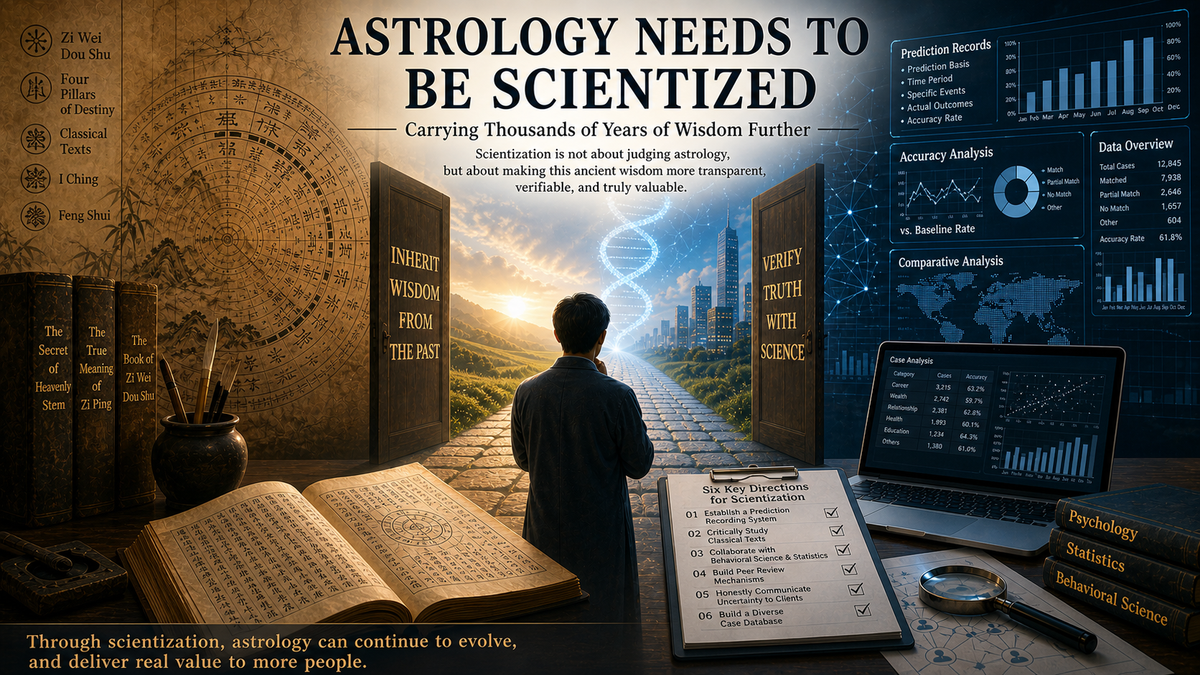
Scientification is not a trial. It's the only path that lets thousands of years of accumulated wisdom finally go further.
Whenever someone suggests that Chinese divination should embrace scientific methodology, the pushback comes quickly: "Divination is metaphysics — it simply doesn't belong in a scientific framework." This sounds like a defense of the tradition. In practice, it functions more like an umbrella that blocks not only outside criticism but also internal reflection.
Scientification was never about measuring divination's "accuracy rate" and issuing a verdict. It means making the reasoning process transparent, allowing sound judgments to be passed down, and making it possible to identify and correct systematic errors. Any discipline with that mechanism will improve. Without it, even the deepest and most ancient knowledge corrodes slowly from within.
Traditional Chinese Medicine: The Most Compelling Precedent
The clearest illustration of this is the trajectory of Traditional Chinese Medicine. The organ system theory and meridian framework of TCM find almost no direct correspondence in anatomy. Descriptions like "the kidney governs bones and produces marrow" or "the liver governs the free flow of qi" operate in an entirely different language from how modern medicine defines organ function. By strict logic — "if it doesn't match established science, it's pseudoscience" — TCM should have been discarded long ago.
It wasn't. TCM not only survived but entered university curricula, established itself as a formal medical discipline, and gained legal recognition in multiple countries around the world. This didn't happen because scientists suddenly lowered their standards. It happened because TCM took the path of scientification: double-blind trials to identify genuinely effective formulas, modern neuroscience to explain the pain-relief mechanisms of acupuncture, pharmacology to analyze the active compounds in herbal medicine.
The process was not entirely smooth. After scientification, some traditional formulas were found to be ineffective; certain preparations containing heavy metals were proven harmful and eliminated. But that is precisely the value of scientification — keeping what genuinely works, removing what causes harm. TCM didn't disappear. It is still TCM. But it became a version of TCM that can be discussed, verified, and improved upon. Divination practitioners should prepare themselves for the same reality: after scientification, some classical formulas and frameworks may be overturned. That is not loss — it is the price of becoming a more credible discipline.
Divination stands at the same crossroads. One path is to keep treating "metaphysics" as a protective shield. The other is to follow TCM's lead and step, with confidence, into a space that can be scrutinized.
Classical Texts Are Not Scripture — They Can Be Wrong
There is a more fundamental reason to support scientification: what the ancient texts say is not necessarily correct.
The knowledge system of Chinese divination rests on a foundation of classical texts — Di Tian Sui, Zi Ping Zhen Quan, Zi Wei Dou Shu Quan Shu — annotated by successive generations and treated as authoritative. But we need to be honest about something: the authors of these texts lived in an era of extreme information scarcity with extremely limited sample sizes. However meticulous their observations, they were accumulating personal experience — not the results of systematic verification. Their conclusions may include genuine patterns, coincidences that were amplified into rules, or reflections of the social biases of their time.
The history of human knowledge is, at its core, a history of successive generations overturning what came before. There was a time when no one believed the earth was round — not because people were foolish, but because the observational tools and verification methods didn't exist. When the tools appeared and the methods were established, the geocentric model was overturned, the heliocentric model was confirmed, and that too was later refined. Each act of "overturning" was not a rejection of the people who came before. It was knowledge itself growing.
A discipline that has lost its ability to update itself is not protecting wisdom — it is manufacturing dogma. If divination treats classical texts as unquestionable scripture, it stops being a living discipline and becomes a museum.
Scientification is precisely how divination becomes a living discipline again. By systematically examining the logical foundations of classical judgments: Which theoretical frameworks have real supporting evidence? Which pronouncements were products of their historical moment and no longer hold? Which core concepts remain valid across centuries? These questions should not be settled by whoever the master happens to be. They require data, records, and open discussion.
Aesthetics Can Be Institutionalized — So Can Divination Judgments
One of the core evaluation criteria in competitive gymnastics and rhythmic gymnastics is "aesthetics" — whether movement is graceful, whether performance flows, whether the overall presentation is moving. Aesthetic judgment, much like a divination practitioner's intuitive reading of a chart, is highly subjective and cannot be fully captured by a single number.
But gymnastics didn't respond to this by saying "aesthetics is art, it can't be scored, so we won't compete." It did something else: it broke aesthetics down into discussable dimensions — execution, artistic impression, choreographic creativity, difficulty coefficient — and built a system where judges, coaches, and athletes continuously debate, revise, and iterate around those dimensions. This scoring framework was not extracted from natural law. It is a consensus that humans constructed through argument. But because it exists, gymnastics can improve, technical differences can be distinguished, and each new generation of athletes has a clear direction to exceed what came before.
The point was never whether a standard originates from natural law. The point is whether that standard is discussed, scrutinized, and verified. That process is exactly what divination lacks.
Today, one practitioner says a hexagram signals financial loss; another says it represents an opportunity in disguise. Both have their own frameworks. There is no mechanism for determining whose reasoning is better founded, and no record to trace which interpretation more consistently approaches reality over time. That is not metaphysical depth. That is a gap where progress should be.
The Subject of Scientification Is Divination Itself
A common misconception needs to be addressed: scientification does not mean waiting for a team of physicists or statisticians to "validate" divination and issue a certificate of legitimacy. That framing is entirely misdirected.
The agent of scientification is the divination community itself. The starting point can be simple: begin systematically recording the reasoning and basis for each reading, track the actual outcomes, and honestly confront which judgments were borne out and which were not. From there, collaboration with researchers in psychology, statistics, and behavioral science becomes possible — using more rigorous methods to analyze accumulated data. This doesn't require practitioners to become scientists. It requires practitioners to develop a scientific mindset: willing to be questioned, willing to revise, willing to let data speak.
Why We Struggle to See Our Own Blind Spots
The greatest crisis facing divination today is not attacks from skeptics. It is the accumulated cognitive bias that results from a long absence of self-correction. Understanding these biases is the first step toward scientification.
The most common is survivorship bias: practitioners and clients alike tend to remember the readings that "came true" while automatically filtering out the many that did not. Over time, this creates the illusion that the system is highly accurate. There is also the Barnum effect: "A part of you longs to be understood, but fears being fully seen" — descriptions vague enough to apply to almost anyone are routinely mistaken for precise chart readings.
More fundamentally, there is confirmation bias: even if practitioners begin keeping records, if the recording process itself involves subjective filtering — for example, retrospectively recalling "which ones came true" — the data is already contaminated. Scientific recording must fix the format before the reading occurs: write down the judgment and its basis first, then wait for the outcome. Don't reconstruct memory afterward. That detail seems small. It is the difference between records that have genuine value and records that are just organized noise.
These biases are not moral failures of individual practitioners. They are structural problems that any knowledge system without external verification mechanisms will inevitably face. Medicine has peer review, clinical trials, and adverse event reporting precisely to combat humanity's innate tendency toward self-confirmation. If divination continues to stay silent on this problem, technical progress will stall, and there will never be a way to distinguish serious researchers from practitioners who survive on persuasion alone.
Where to Start: Six Concrete Directions
Scientification sounds vast. It can begin with very specific actions.
01 — Build a prediction recording system with baselines When making a judgment, simultaneously record the reasoning, time frame, and specific claims — critically, record at the moment of reading, not afterward. After a period of time, return and honestly calculate accuracy and error rates. But accuracy rates mean nothing in isolation. What matters is comparison against a baseline: what is the probability of random chance? What proportion of people generally encounter a similar situation in that time period? A divination judgment must exceed that baseline to count as genuinely effective — not simply a statement that applies to everyone.
02 — Promote critical reading of classical texts Stop using "that's what the classical text says" as a closing argument. Keep asking: What was the sample behind this judgment? Does it still hold in modern cases? Which parts might reflect the limitations of the era? Build a culture where it is acceptable to openly debate whether classical texts are right or wrong — not treat questioning tradition as disrespect.
03 — Collaborate with behavioral science and statistics Practitioners don't need to conduct research themselves. They can provide data and questions, and bring in people with research methodology to analyze them together. This kind of cross-disciplinary collaboration is one of the core pathways through which TCM achieved scientification.
04 — Establish peer discussion and review mechanisms When practitioners disagree on a reading, don't resolve it with "everyone has their own school of thought." Seriously discuss the differences in reasoning. Disagreement and debate are prerequisites for progress. A field with no internal culture of criticism only moves in circles.
05 — Honestly communicate uncertainty to clients One of the core principles of scientific thinking is the ability to say "I don't know." Actively clarifying which judgments are inferences and which are highly uncertain is both responsible toward clients and an honest reckoning with the limits of one's own skill. This doesn't undermine trust. It builds more durable trust.
06 — Build a diverse case database In the long run, divination needs a research-accessible data foundation. But the value of that database depends on sample diversity. A database that only includes clients who actively sought consultation — people who already believe in divination — will produce conclusions skewed by selection bias, applicable only to a specific subgroup rather than people in general. An effective database needs to track subjects with varied backgrounds and varying degrees of belief, so that analytical results carry genuine explanatory power.
What Scientification Means for Practitioners
There is a structural tension here that needs honest acknowledgment. In the short term, scientification genuinely increases costs for individual practitioners and compresses the room to operate under ambiguity. When judgments must be grounded, predictions must be recorded, and reasoning must be open to scrutiny, practitioners who survive on persuasion will understandably feel threatened.
But from another angle, this is precisely the protection that serious practitioners most need. Today, the barrier to entry in divination is nearly zero. Anyone can hang a sign and call themselves a practitioner. In that environment, people who genuinely invest time in research and have the capacity for rigorous judgment are drowned out by a flood of lower-quality services, with no way for clients to tell the difference. The standards that scientification establishes are, in the long run, the mechanism by which good practitioners become identifiable. The problem of bad practice crowding out good practice can only be solved by building standards — not by maintaining ambiguity.
After Scientification, Divination Is Still Divination
One last concern deserves a direct response: after scientification, will divination lose its cultural depth and interpretive space, reduced to a cold statistical model?
TCM provides the answer. After scientification, TCM did not become Western medicine. Acupuncture is still acupuncture. The yin-yang and five-element framework is still there. It simply gained a language that can engage with the modern world. Gymnastics, after building its scoring system, did not lose its artistic dimension — it gained one. Because technical standards were established, the space for artistic expression became deeper and more layered.
Scientification is addition, not replacement. It gives divination a set of tools for self-improvement, so that centuries of accumulated observation and insight can be passed on with more precision and applied with more effectiveness — rather than gradually distorted through generations of oral transmission.
A discipline willing to accept scrutiny is one that deserves to be taken seriously in this era. Chinese divination has the depth to withstand that scrutiny. The only question is whether its practitioners are willing to take that step.